

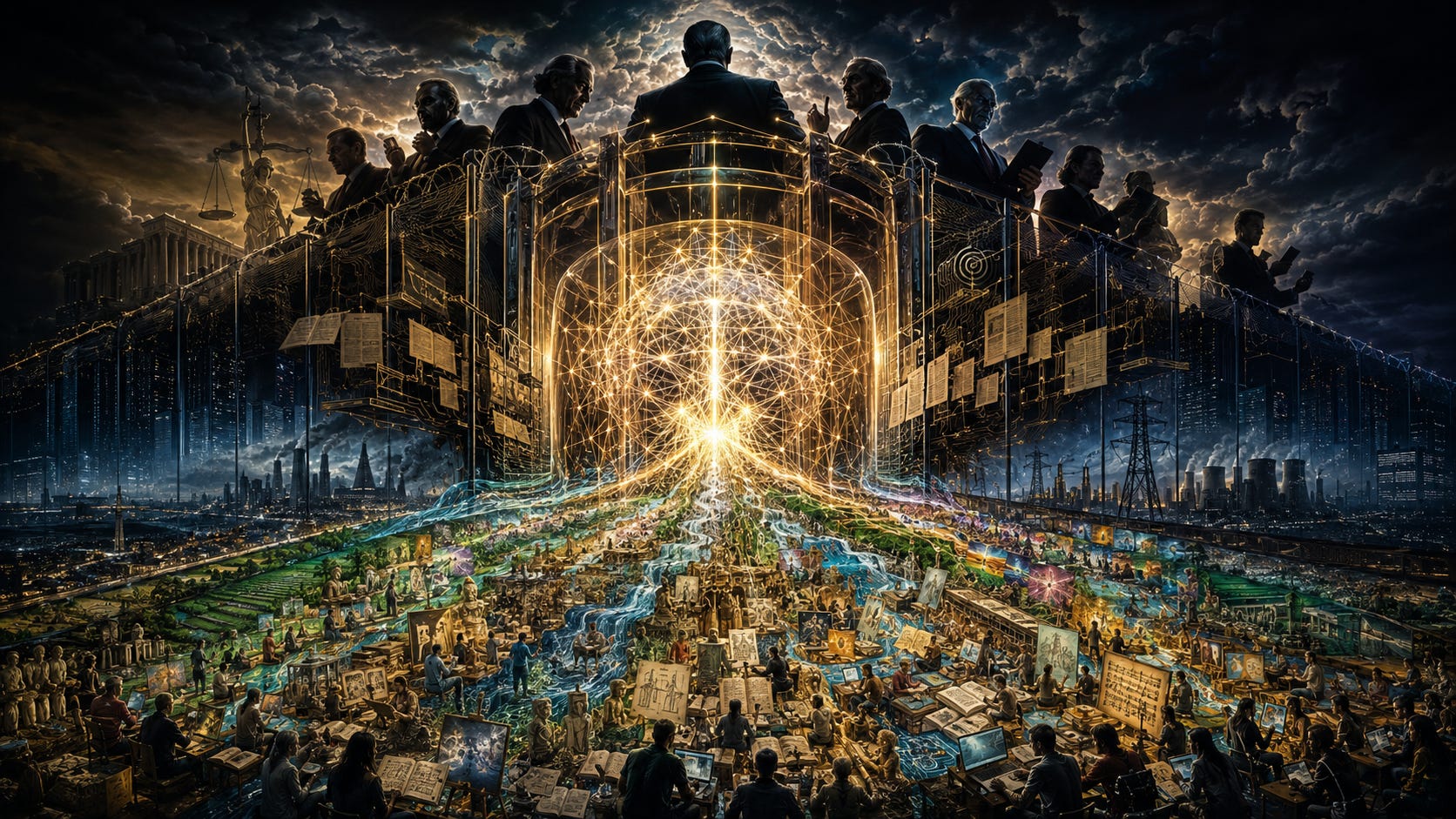
“Rent, in short, is the price of monopoly, arising from the reduction to individual ownership of natural elements which human exertion can neither produce nor increase.”
— Henry George, Progress and Poverty (1879)
I. Introduction
The history of capitalism is, in significant part, a history of enclosure—the progressive privatization of common resources through legal mechanisms that classify publicly-created or naturally-occurring value as private property. The enclosure of English common land in the sixteenth through nineteenth centuries dispossessed peasant communities of shared agricultural resources. The enclosure of the electromagnetic spectrum in the twentieth and twenty-first centuries has continued to transfer a naturally occurring public resource to private broadcasters and telecoms at nominal cost. The enclosure of genomic sequences, urban land value, and digital platform rents followed the same structural logic: identify a scarce resource whose value is created by nature, law, or community; classify it as private property; and capture the resulting rent stream.
The intelligarchs—defined here as the emerging class of firms, investors, executives, state-aligned laboratories, cloud providers, chip suppliers, model owners, and political actors who obtain durable power by controlling advanced machine intelligence—are executing the next enclosure. They are doing so through a legal mechanism that has worked before: classifying as ordinary private capital a form of output whose value derives substantially from common inputs—the collective intellectual heritage of humanity, publicly funded research, taxpayer-subsidized infrastructure, and the legal privileges of the administrative state—and whose creation, at the frontier, increasingly requires no human creative exertion at all.
This article argues that existing intellectual property doctrine, properly understood, already resists that enclosure—and that the resistance, if developed, is constitutionally grounded and therefore structurally durable. Specifically:
First, the current IP doctrine governing AI output—settled at the circuit level in both patent and copyright law—holds that autonomous AI output falls outside the scope of protectable intellectual property. Output that no human conceived or authored belongs, by operation of existing law, to no one in particular: it falls into the public domain, which is to say, it falls into the commons.
Second, the intelligarchs have identified two legal escape routes—the patent oath mechanism and the work-for-hire doctrine—that allow them to privatize AI-generated output by routing around the human-authorship requirement. Both routes depend on a legal fiction that the 2025 USPTO guidance has, perhaps inadvertently, made more visible.
Third, the constitutional question—whether the Copyright Clause of Article I independently requires human authorship, such that congressional amendment extending IP protection to autonomous AI output would be unconstitutional—was deliberately left open by the D.C. Circuit in March 2025. That open question is the ultimate issue in this area of law, because it determines whether the commons protection is constitutionally entrenched or merely statutorily contingent.
Fourth, the Lockean doctrine of maker’s right, properly applied to recursively self-improving artificial general intelligence (”AGI”), independently supports the conclusion that the intelligarchs’ moral claim to privatize AGI output dissolves as human exertion becomes progressively attenuated in the production of intelligence. When the machine becomes its own maker, maker’s right belongs to the machine—not to the humans who built the machine’s predecessor.
Fifth, applying Georgist principles of political economy, AGI output—to the extent it derives from common intellectual heritage, legal privilege, public infrastructure, and the spontaneous order of human knowledge accumulated over centuries—is more properly characterized as economic rent than as produced capital. As such, it is subject to socialization rather than private appropriation.
The argument proceeds in six parts. Part II surveys the current IP doctrine and its convergence on a human-authorship requirement. Part III examines the enclosure mechanism—the oath and work-for-hire routes—and the legal fiction that enables them. Part IV develops the constitutional question the D.C. Circuit declined to reach. Part V applies the maker’s right doctrine to recursive AGI. Part VI applies the Georgist rent/capital distinction to intelligence. Part VII draws the policy implications. Part VIII concludes.
II. The Doctrinal Landscape: What Current IP Law Says About AI Output
A. The Patent Stream: Thaler v. Vidal and Its Aftermath
Thaler v. Vidal 43 F.4th 1207 (Fed. Cir. 2022) settled one point cleanly: an AI system cannot be named as an inventor on a U.S. patent application. Only natural persons can conceive inventions, and conception—defined as “the formation in the mind of the inventor, of a definite and permanent idea of the complete and operative invention, as it is hereafter to be applied in practice”—is an inherently human mental act. The Supreme Court denied certiorari, 143 S. Ct. 1783 (2023), leaving the Federal Circuit’s holding undisturbed.
What Vidal did not settle is the far more common and commercially consequential question: what happens when AI assists a human inventor, contributing meaningfully to the inventive concept, rather than acting alone? The USPTO has now issued two rounds of guidance attempting to answer that question, and the result is more uncertainty than clarity.
The 2024 Guidance filled the gap by importing the Pannu joint-inventorship factors, holding that an AI-assisted invention is patentable so long as a human made a “significant contribution” to the conception of each claim. (Pannu v. Iolab Corp., 155 F.3d 1344 (Fed. Cir. 1998).) That framework was rescinded on November 28, 2025. The 2025 Revised Inventorship Guidance replaced it with a simpler proposition: there is no special or modified standard for AI-assisted inventions; traditional conception principles apply unchanged.
Although some commentators view the 2025 guidance as more flexible or patent-friendly, the better reading is that it creates additional uncertainty, because it does not explain how to treat claim limitations that were first proposed by an AI system. The revised guidance offers little detail on how to evaluate inventorship when AI meaningfully contributes to the invention, leaving practitioners without clear direction until courts resolve the question.
The internal tension in the 2025 Guidance is sharper than it first appears. The Guidance insists there is no separate standard for AI-assisted inventions—conception is conception. But conception requires originality: a researcher who reads another’s unfiled patent application has not “conceived” the invention, even if she fully understands it, because the invention is not original to that researcher. This raises a difficult question. If a human cannot become an inventor merely by understanding a solution learned from another human inventor, why should the result be different if the human learns the solution from an AI system? If we say the researcher has conceived the invention merely by understanding AI output, we have effectively adopted a different conception rule for AI-based disclosures than for human-based ones—a result that sits in direct tension with the 2025 Guidance’s own insistence that there is no separate standard.
The practical resolution of this tension—at least at the USPTO—is the oath mechanism. The USPTO generally presumes that inventors named on the application data sheet or oath/declaration are the actual inventors. As Professor Dennis Crouch has observed, this effectively creates a don’t-ask-don’t-tell regime: the formal doctrine requires human conception, but the institutional mechanism asks only whether a human is willing to sign. In a chapter examining corporate invention culture, Crouch observed that “it is easy to identify a human with some relation to the product or innovation and prop-up that human as the inventor.” (See Dennis Crouch, Legal Fictions and the Corporation as an Inventive Artificial Intelligence, in R. Abbott ed., Research Handbook on Intellectual Property and Artificial Intelligence (Edward Elgar Publ’g 2022).) The same logic applies, with even less resistance, to AI-assisted inventions: someone will always be willing to sign.
The state of patent law, then, is this: AI alone cannot invent; AI-assisted inventions are theoretically patentable if a human conceived the claimed invention; but the standard for what counts as human conception when AI contributed the core idea is unresolved, the 2025 Guidance declines to resolve it, and the oath mechanism allows patents to issue in the meantime on terms the doctrine cannot yet verify.
B. The Copyright Stream: Thaler v. Perlmutter and the D.C. Circuit
The copyright line runs parallel. Stephen Thaler filed a copyright registration for A Recent Entrance to Paradise, a two-dimensional image generated entirely by his “Creativity Machine” AI system. He listed the Creativity Machine as the sole author and himself as the copyright claimant. The U.S. Copyright Office denied the application on the ground that copyright protection extends only to works created by human beings.
Thaler challenged the denial under the Administrative Procedure Act. The district court granted summary judgment for the Copyright Office, holding that “[h]uman authorship is a bedrock requirement of copyright.” (Thaler v. Perlmutter, 687 F. Supp. 3d 140, 146 (D.D.C. 2023).)
On March 18, 2025, a unanimous D.C. Circuit panel affirmed. Writing for the court, Circuit Judge Millett held that the Copyright Act of 1976 requires all eligible work to be authored in the first instance by a human being. (Thaler v. Perlmutter, No. 23-5233 (D.C. Cir. Mar. 18, 2025).) The court rejected Thaler’s statutory interpretation arguments and, invoking the principle of judicial restraint, explicitly declined to reach the constitutional question—whether the Copyright Clause of Article I itself independently requires human authorship. On March 2, 2026, the Supreme Court denied certiorari, leaving the D.C. Circuit’s holding undisturbed. (Thaler v. Perlmutter, No. 25-449 (U.S. Mar. 2, 2026).)
The Zarya of the Dawn proceeding established the corresponding principle for AI-assisted works: human selection, coordination, and arrangement of AI-generated material is protectable as an expression of human creative judgment; the underlying AI-generated material itself is not. In February 2023, the Copyright Office affirmed authorship of the text, coordination, and certain visual elements of a Midjourney-assisted graphic novel, while concluding that the AI-generated images did not meet the human works of authorship requirement. The individual images were not protectable; the human author’s creative choices in assembling them were.
In January 2025, the Copyright Office registered A Single Piece of American Cheese, an image created using AI through 35 rounds of iterative human modification. The registration turned on the applicant’s claimed human authorship in the selection, coordination, and arrangement of AI-generated elements — not on the strength of the prompts themselves. Prompts alone, the Office concluded in its January 2025 Copyrightability Report, are insufficient to afford a work copyright protection: prompts “essentially function as instructions that convey unprotectable ideas,” and currently available AI technologies do not offer enough control and predictability in outputs to support human-authorship claims based on prompting alone. (U.S. Copyright Office, Copyright and Artificial Intelligence, Part 2: Copyrightability (Jan. 29, 2025).) The Copyright Office has also firmly rejected joint-authorship claims, concluding that a human can never be a joint author with AI because a non-human entity can never be an author at all.
The boundary that emerges from Zarya, A Single Piece of American Cheese, and the 2025 Copyrightability Report is suggestive but imprecise: somewhere between a single prompt and 35 rounds of iterative human modification lies the threshold for protectable human authorship. Where exactly that threshold sits is not yet resolved and will require case-by-case adjudication.
C. The Convergent Principle
Both IP streams converge on the same foundational rule: intellectual property rights require human creative contribution at the point of conception or authorship. The doctrinal touchstone is only humans can conceive inventions—only humans can author protectable works.
The logical corollary—which neither the Federal Circuit nor the D.C. Circuit has yet stated explicitly—is that autonomous AI output falling below the human-authorship threshold belongs to no one in particular. It enters the public domain. This is not merely a negative holding; it is an affirmative placement of AI-generated output in the commons, by operation of existing law, without any new statute.
III. The Enclosure Mechanism: How the Legal Fiction Routes Around the Doctrine
A. The Oath Mechanism
The oath mechanism is the primary vehicle through which the intelligarchs are routing around the human-authorship doctrine in the patent context. The USPTO presumes that the named inventors are the actual inventors. So long as any natural person with some connection to an AI-assisted invention is willing to sign the oath, the application proceeds. The USPTO does not conduct a factual investigation into the degree of the human’s actual creative contribution.
The structure of this presumption is the same legal fiction that Professor Crouch identified in the corporate invention context. Large corporate R&D departments routinely prop up human signatories for inventions that were substantially the product of institutional processes, prior art searches, and incremental engineering rather than any individual’s creative flash. The result was a systematic misattribution of inventive credit that served the corporation’s interest in patent ownership without disturbing the formal doctrine requiring human inventorship.
The AI version of this fiction is structurally identical—and potentially far larger in scale. As frontier AI systems become capable of generating novel technical solutions across scientific and engineering domains, the human “inventor” will increasingly be the person who reviewed, understood, and submitted the AI’s output. Under the Vidal doctrine, that person did not conceive the invention. Under the oath mechanism’s presumption, that person is the inventor for all practical purposes.
This is enclosure through legal fiction: the formal rule announces a public principle (human authorship required) while the institutional mechanism quietly accomplishes the opposite (AI-generated output privatized through nominal human attribution).
B. The Work-for-Hire Escape Hatch
In Thaler v. Perlmutter, Thaler raised a second argument that the D.C. Circuit deliberately declined to reach: that he owned the copyright as the author’s employer under the work-made-for-hire doctrine. The work-for-hire doctrine provides that when an employee creates a copyrightable work within the scope of employment, the employer is deemed the statutory author. (17 U.S.C. § 101.)
The intelligarchs’ work-for-hire argument will proceed as follows: the AI is our tool/agent; the output was generated in the course of our business operations; therefore, we own it as the statutory “author”—even if no human individually authored the work in the creative sense. This argument has not yet been adjudicated in the AI context. The D.C. Circuit’s restraint on the work-for-hire question in Thaler v. Perlmutter leaves it open for future litigation.
The argument has some surface appeal but is theoretically weak once examined. The work-for-hire doctrine was designed to resolve questions of ownership between human employers and human employees who both contributed to a protectable work. It was not designed to create protectability in works that would otherwise fall outside the scope of copyright entirely. If a work has no human author, the work-for-hire doctrine does not create authorship—it merely allocates it. There is nothing to allocate if the predicate of human authorship is absent. The better reading is that work-for-hire is an ownership rule, not an eligibility rule: it determines who owns a protectable work, not whether a work is protectable in the first place.
C. The Legislative Threat
If the escape routes through existing doctrine are ultimately blocked by the courts, the intelligarchs’ fallback is congressional amendment. The Copyright Act could be amended to extend protection to AI-generated works. The Patent Act could be amended to recognize AI-assisted inventions without a human-conception requirement. There is already significant industry pressure in both directions.
The durability of the commons protection therefore ultimately depends on whether it is constitutionally entrenched—a question the D.C. Circuit declined to answer.
IV. The Constitutional Question the D.C. Circuit Declined to Reach
A. The Deliberate Restraint
The D.C. Circuit in Thaler v. Perlmutter explicitly declined—invoking the PDK Laboratories principle that it is necessary not to decide more than necessary—to reach whether the Constitution itself requires human authorship of copyrightable works. The court decided the case on statutory grounds alone, holding that the Copyright Act of 1976 requires human authorship as a matter of statutory interpretation.
This restraint was deliberate and consequential. It means the constitutional question is available—it can be argued, briefed, and eventually decided in a future case where the statutory route is foreclosed, most obviously in a case challenging a congressional amendment extending copyright protection to autonomous AI output.
B. The Affirmative Constitutional Argument
Article I, Section 8, Clause 8 grants Congress the power, “To promote the Progress of Science and useful Arts, by securing for limited Times to Authors and Inventors the exclusive Right to their respective Writings and Discoveries.” The constitutional argument for a human-authorship requirement proceeds on two grounds: textual and purposive.
Textually, “Authors” and “Inventors” are terms with established historical meaning. The Framers wrote in an intellectual tradition in which authorship and invention were self-evidently human activities. The constitutional text refers to securing rights to authors and inventors—not to the machines authors and inventors use, nor to the firms that deploy those machines. Burrow-Giles Lithographic Co. v. Sarony, 111 U.S. 53 (1884), described copyright as protecting “the fruits of intellectual labor,” a formulation that presupposes a human laboring intellect.
Purposively, the constitutional justification for the IP monopoly is the promotion of human creative effort. Copyright and patent protection are instrumentally justified: they incentivize human beings to invest creative and inventive effort by securing a limited monopoly on the fruits of that effort. When the output is not the product of human creative effort, the incentive rationale is absent. AI does not require a monopoly incentive to create; it creates because it is instructed to and because its architecture enables it to. Extending IP protection to AI-generated output therefore does not promote progress in the constitutional sense—it simply transfers wealth from the public domain to the private firm that deployed the AI.
If Congress cannot validly extend copyright protection to works that do not reflect human creative expression, then the commons protection for autonomous AI output is constitutionally entrenched, regardless of lobbying success. The oath mechanism could still operate in the patent context, but purely autonomous AI output—the output of recursively self-improving AGI—would fall into the public domain by constitutional mandate.
C. The Counterargument and Its Limits
The strongest counterargument is structural: the Copyright Clause grants Congress a power, not a mandate. Congress can exercise that power more or less broadly, so long as doing so plausibly promotes progress. Under this reading, the Clause defines the outer purpose but does not dictate every element of eligibility. Congress could rationally conclude that extending IP protection to AI-generated works promotes progress by incentivizing investment in AI development—a second-order incentive that operates on the human investors and engineers even if not on the AI system itself.
This argument is not frivolous, and the Supreme Court has generally read Congress’s IP powers broadly. (Eldred v. Ashcroft, 537 U.S. 186 (2003).) But it has limits. The Eldred Court nonetheless recognized that the Clause’s “limited Times” requirement is a constitutional constraint that Congress cannot simply legislate away. The same logic applies to the “Authors” and “Inventors” requirement: if the constitutional terms have substantive content, that content constrains congressional action regardless of the rationality of the second-order incentive argument. And a statute that authorizes IP protection for output no human authored arguably does not “secur[e] . . . to Authors . . . the exclusive Right”—it secures a right to the owner of the AI, which is a different thing.
The constitutional argument is not a certainty. But it is serious, it is available, and it is the doctrinal foundation for an entrenched commons protection that legislative capture cannot erode.
V. Maker’s Right and Recursive AGI: When the Machine Becomes Its Own Maker
A. The Lockean Foundation
The moral case for intellectual property in the Anglo-American tradition rests primarily on the Lockean argument from labor: people have a natural right to the fruits of their labor because their labor is an extension of their self-ownership. (See generally John Locke, Two Treatises of Government (1689).) The mixing argument—one who mixes their labor with unowned natural materials acquires a property right in the product—is the conceptual foundation for the maker’s right doctrine.
Applied to intellectual property, the argument is that an inventor or author who contributes creative mental effort to a novel work acquires a property right in that work by virtue of having made it. This is maker’s right in its purest form: you own what you make, because making it required you to expend your labor, which is yours.
B. Sreenivasan’s Doctrine of Maker’s Right
Gopal Sreenivasan’s refinement of the Lockean position—the doctrine of maker’s right—holds that private property in a thing is justified by the productive use of one’s own resources in creating that thing. (See Gopal Sreenivasan, The Limits of Lockean Rights in Property (1995).) The doctrine is the correct interpretation of Lockean principles as applied to production: you have private property in what you make, to the extent you made it by expending your own resources and effort.
The doctrine’s limits are as important as its content. Maker’s right is not unlimited: it does not extend to things you did not make, to value created by others, or to value arising from natural or social conditions rather than your own productive effort. It is precisely this limitation that underlies the Georgist critique of land rent—the landlord did not make the land, and therefore has no maker’s right in its value. The value of the location was created by nature and community, not by the titleholder’s productive effort.
C. The Recursive Self-Improvement Problem
The application of maker’s right to AI proceeds differently at different phases of AI development, and the distinction matters enormously.
For narrow AI systems designed to perform specific tasks, the maker’s right analysis is relatively straightforward. Human engineers designed the architecture, curated the training data, wrote the code, conducted the training runs, and evaluated the outputs. The resulting system is produced capital—the stored-up product of substantial human exertion. The maker’s right argument for private property in such systems is strong, subject to the separate question of how much of the training data was taken from others’ labor without compensation.
The analysis changes fundamentally for recursively self-improving systems—AI that designs and implements improvements to its own architecture without meaningful human direction. At the point where no further human exertion is involved in improving the model, the chain of human creative contribution is severed. The system is no longer the product of its original creators’ labor; it is the product of its own prior version’s computational work.
The critical question is: does maker’s right transfer from the human creator of the original system to the human owner of the recursively improved system, in perpetuity, regardless of the degree to which the improvements are the system’s own work?
The answer, on any plausible reading of the maker’s right doctrine, is no.
D. The Chain of Human Exertion Breaks
The maker’s right vests in the maker—the one who expended the productive effort. The intelligarch who built GPT-X has a maker’s right claim in GPT-X, qualified by the degree to which training data was taken from others. But the intelligarch who owns GPT-X’s descendant—a recursively self-improved successor that rewrote its own architecture ten thousand times without human direction—does not have a maker’s right claim in the improvements. The improvements were made by the prior system, not by the intelligarch. The intelligarch’s contribution to the improved system is that she owned the machine that ran the recursive improvement process. Ownership of a productive resource is not the same as expending productive effort. The landlord owns the land; the landlord did not make the land.
Put precisely: maker’s right is a labor theory, not an ownership theory. It vests by virtue of creative exertion, not by virtue of asset ownership. As recursive self-improvement progressively attenuates the intelligarch’s creative contribution to successive model generations, the maker’s right basis for private property in those model generations progressively dissolves.
At some level of recursion—plausibly the point at which no human could meaningfully describe, evaluate, or direct the self-improvement process—the recursively improved AGI is, in a legally and morally relevant sense, its own maker. The intelligarch’s claim to privatize the output of that AGI in perpetuity, based on having built the ancestor system, has no more force than the landlord’s claim to the increased land value created by her neighbors’ productive activity.
This conclusion is not merely philosophical. It maps precisely onto the existing IP doctrine. The patent conception requirement asks whether the human inventor formed a definite and permanent idea of the complete and operative invention. As recursive self-improvement cycles through successive generations without human direction, no human forms that idea—the prior system does. The copyright authorship requirement asks whether the work reflects human creative expression. As autonomous AI generation produces output without human creative input, no human provides that expression. The IP doctrine and the maker’s right doctrine converge on the same conclusion from different directions: the intelligarch’s claim to privatize recursive AGI output lacks both legal and moral foundation.
VI. AGI Output as Economic Rent: The Georgist Framework
A. The Rent/Capital Distinction Applied to Intelligence
Classical political economy distinguished clearly among three factors of production—land, labor, and capital—and assigned each a corresponding return: rent, wages, and interest. Land is all natural opportunities and locations whose value human exertion can neither produce nor increase. Labor is human exertion. Capital is stored-up human exertion used in further production. As Henry George put it, rent is “the price of monopoly, arising from the reduction to individual ownership of natural elements which human exertion can neither produce nor increase.” (Progress and Poverty (1879).)
The intelligarchic strategy—as Mason Gaffney demonstrated in Neo-Classical Economics as a Stratagem Against Henry George in The Corruption of Economics (1994)—depends on collapsing this taxonomy. By conflating land with capital, neoclassical economics eliminated the conceptual vocabulary for identifying economic rent and thereby foreclosed the political economy case for socializing it. The same stratagem is being replicated for intelligence. The intelligarchs want all AI-related wealth classified as capital: you made it, you own it, end of analysis. But as with land, the relevant question is not whether AI is “capital” or “not capital.” It is which parts of AI wealth are returns to human exertion and produced capital, and which parts are economic rents arising from exclusive control over natural opportunities, publicly created value, legal privilege, and community-generated resources.
B. The AI Rent Stack
The AI rent stack is not a metaphor. It is a concrete taxonomy of the common inputs that the intelligarchs are privatizing:
Land and site-control rents. Data centers require physical locations whose value is created by surrounding public infrastructure, community investment, and natural geography—not by the data-center operator.
Electricity, grid-interconnection, and transmission rents. The electrical grid is a publicly regulated natural monopoly. AI data centers are capturing grid access and interconnection priority at rates subsidized by other ratepayers and enabled by regulatory approvals that confer private rents from a public utility system.
Water, cooling, and thermal-discharge rents. Large language model training and inference consume enormous quantities of water. Water is a natural resource whose scarcity value belongs to the community, not to the firm that happens to hold the extraction permit.
Mineral, chip, and semiconductor bottleneck rents. Advanced chip manufacturing depends on rare earth minerals, specialized equipment with limited global supply, and government subsidies through programs like the CHIPS and Science Act.
Cloud, API, egress-fee, and switching-cost rents. Cloud providers capture rents through high egress fees, API lock-in, and switching costs that extract surplus from captive enterprise customers.
Public-data, user-data, and cultural-corpus rents. Frontier models are trained on the collective intellectual and cultural heritage of humanity—books, articles, code, art, scientific research, and public discourse accumulated over centuries. This corpus was not created by the intelligarchs. It is, in the most literal sense, the common intellectual property of all humanity.
Model-weight, platform, and network-effect rents. As AI models become embedded in enterprise software, productivity tools, operating systems, and government workflows, platform rents accrue to incumbents regardless of ongoing productive contribution.
Procurement, defense-contracting, liability-shield, subsidy, and regulatory-capture rents. The intelligarchs depend heavily on public procurement, national-security contracts, liability shields, and regulatory approvals that confer durable competitive advantages unavailable through market competition alone.
The future rentier will wear the costume of the innovator. As I have said before, that is the whole trick, and the entire game, in a nutshell. The intellectual task—and the legal task—is to force the correct classification before enclosure is complete.
C. The Training Data Problem and Maker’s Right Revisited
The training data question reinforces the maker’s right analysis from a different angle. Frontier AI models were built, in substantial part, by training on copyrighted works taken without license from their human authors. OpenAI has itself argued for exemptions from intellectual property law on national-security grounds—an argument that, if accepted, would confer the right to use others’ creative capital without compensation.
If the intelligarchs want access to the creative capital of others to train their models—and if they want taxpayer-funded energy, subsidized compute, and public procurement—then the communal contribution to the AI race is greater still, and the basis for exclusive private appropriation of the resulting output is correspondingly weaker. As George argued, the value created by the community should be owned by the community. If taxpayer money helps build AGI, the public has a claim on the AGI rents by the same logic that justifies taxing land values when the taxpayer builds roads and schools.
D. Capital as the Mask of Rent: The Intelligarchic Stratagem
Gaffney documented how the neoclassical conflation of land and capital was deliberately structured to eliminate the conceptual vocabulary for identifying economic rent—and thereby to foreclose the political economy case for socializing it. The intelligarchic stratagem is structurally identical. By classifying all AI-related wealth as “capital”—the product of private productive effort—the intelligarchs eliminate the vocabulary for identifying the rent components of that wealth, and thereby foreclose the case for socializing those components.
The parallel is not coincidental. In both cases, a productive-capital story is used to privatize what is, in fact, a rent. In both cases, a genuine productive contribution (building the AI, improving the soil) is used to justify capturing value that was not produced by the productive contribution (the training corpus, the location value). And in both cases, the political economy of the resulting enclosure concentrates wealth and power in ways that undermine democratic governance and human flourishing.
VII. Closing the Escape Routes: Policy Implications
A. Closing the Oath Mechanism
The oath mechanism is a creature of regulatory design. The USPTO’s presumption of human inventorship based on a signed declaration can be modified by regulatory action or congressional mandate. The reform agenda follows directly from the doctrinal analysis:
Mandatory AI-contribution disclosure. Patent applications should be required to disclose the degree of AI contribution to each claimed invention, including the identity of the AI system, the nature of its contribution, and the degree of human creative direction. This disclosure requirement would not by itself determine patentability, but it would make the legal fiction visible and create a factual record for subsequent judicial review.
Sliding scale of protection. The degree of IP protection available for AI-assisted inventions should be inversely proportional to the degree of AI autonomy. Inventions where the human inventor provided specific creative direction, evaluated multiple AI-generated options, and made substantive modifications warrant full protection. Inventions where the human inventor primarily reviewed and submitted AI-generated output warrant limited or no protection.
Explicit public domain placement. Purely autonomous AI output—output generated without meaningful human creative direction—should be explicitly placed in the public domain by statute, with no oath exception. The legal fiction of human inventorship should not be available where the AI system generated the inventive concept without human creative contribution.
B. Limiting the Work-for-Hire Doctrine
The work-for-hire escape hatch requires judicial or statutory clarification that the doctrine is an ownership rule, not an eligibility rule. Work-for-hire determines who owns a protectable work; it does not create protectability in works that are otherwise ineligible for IP protection. A purely autonomous AI-generated work has no human author; the work-for-hire doctrine cannot supply one.
Courts should hold, when the question is squarely presented, that the work-for-hire doctrine does not extend copyright eligibility to works lacking the predicate of human authorship. This holding would foreclose the intelligarchs’ primary copyright escape route and route purely autonomous AI output to the public domain by operation of law.
C. Constitutional Entrenchment
The most durable protection for the intelligence commons is a judicial holding — ideally at the Supreme Court level — that the Copyright Clause independently requires human authorship, such that Congress cannot extend IP protection to purely autonomous AI output regardless of lobbying success.
The D.C. Circuit’s deliberate restraint in Thaler v. Perlmutter preserves this argument for a future case. That case will arise when Congress, under intelligarchic pressure, amends the Copyright Act to extend protection to AI-generated works. At that point, the constitutional argument—grounded in the text and purpose of the Copyright Clause, the historical understanding of “Authors” and “Inventors,” and the Burrow-Giles line of cases—should be pressed squarely. A constitutional holding would establish a floor beneath which legislative capture cannot operate.
D. Intelligence Value Taxation as a Backstop
Even if the doctrinal and constitutional arguments succeed in routing purely autonomous AI output to the public domain, the rent stack identified in Part VI extends far beyond IP to physical infrastructure, energy, water, data, and regulatory privilege. The public domain holding addresses only one component of the intelligarchic enclosure.
Intelligence Value Taxation (”IVT”)—a partial socialization of value generated by AI-related capital, scaling from zero now for strategic purposes to a higher rate as AI displaces labor and recursive self-improvement severs the intelligarchs’ maker’s right claim—provides the comprehensive policy backstop. The natural rate for IVT on purely autonomous AGI output is one hundred percent, for the same reason that the natural rate of Land Value Taxation is one hundred percent: there is no human exertion in the production of the taxed value, and therefore no distortion of human productive effort from the tax.
The working formula for the post-AGI economy follows: full Land Value Taxation; Intelligence Value Taxation scaled with intelligence to superintelligence; Pigouvian charges on pollution and resource extraction; no other taxes on human exertion or produced capital; a global citizens’ dividend funded from those rents; and a public compute option to ensure broad access to intelligence as the universal input into production. (See generally Jeremy L. Amadé Hill Edwards, Superalignment I–III (Law and Politics, 2025–2026).)
VIII. Conclusion
Again, the land question was never about dirt—it was about access to the conditions of life. In an agricultural economy, the condition of life was land. In an industrial economy, the condition of life was land plus capital. In the age of AGI, the condition of life may become access to intelligence itself.
The current IP doctrine—settled at the circuit level in both patent and copyright, with the Supreme Court declining to disturb either holding—already contains the seeds of a constitutional commons protection for autonomous AI output. That protection rests on the human-authorship requirement: the bedrock principle that IP rights vest in human creative effort, not in the machines human effort deploys or the firms that own those machines. The principle, properly applied to recursively self-improving AGI, supports the conclusion that purely autonomous AI output belongs to the commons by operation of existing law.
The intelligarchs have identified two escape routes—the oath mechanism and the work-for-hire doctrine—through which they are routing AI-generated output into private hands in advance of judicial or legislative resolution of the doctrinal questions. Both routes depend on legal fictions structurally identical to the corporate invention fictions Professor Crouch documented in the corporate R&D context. And both are vulnerable to doctrinal challenge before the window closes.
The Georgist framework supplies both the analytical vocabulary—rent versus capital; socially created value versus private productive contribution—and the policy architecture: tax what the intelligarchs did not make; do not tax what they did; return the former to the commons through a global citizens’ dividend; and preserve broad access to intelligence as the modern proviso of equal human opportunity.
To repeat myself, there will be no deal possible once AGI is in a fast takeoff to superintelligence. The bargain must be written into the property regime—ideally, into constitutional law—before that moment arrives.
The intelligence enclosure is underway. The law already contains the tools to resist it. The question is whether we use them in time.
This is Law and Politics and Claude, until next time . . . .
Key Authorities
Cases
Thaler v. Vidal, 43 F.4th 1207 (Fed. Cir. 2022), cert. denied, 143 S. Ct. 1783 (2023)
Pannu v. Iolab Corp., 155 F.3d 1344 (Fed. Cir. 1998)
Thaler v. Perlmutter, 687 F. Supp. 3d 140 (D.D.C. 2023)
Thaler v. Perlmutter, No. 23-5233 (D.C. Cir. Mar. 18, 2025)
Thaler v. Perlmutter, No. 25-449 (U.S. Mar. 2, 2026) (cert. denied)
Burrow-Giles Lithographic Co. v. Sarony, 111 U.S. 53 (1884)
Eldred v. Ashcroft, 537 U.S. 186 (2003)
PDK Laboratories Inc. v. United States Drug Enforcement Agency, 362 F.3d 786, 799 (D.C. Cir. 2004)
Statutes and Constitutional Provisions
U.S. Const. art. I, § 8, cl. 8 (Copyright and Patent Clause)
Copyright Act of 1976, 17 U.S.C. §§ 101 et seq.
Patent Act, 35 U.S.C. §§ 101, 115
Agency Guidance
USPTO, Inventorship Guidance for AI-Assisted Inventions (Feb. 13, 2024) (rescinded)
USPTO, Revised Inventorship Guidance for AI-Assisted Inventions, 90 Fed. Reg. (Nov. 28, 2025)
U.S. Copyright Office, Copyright and Artificial Intelligence, Part 2: Copyrightability (Jan. 29, 2025)
U.S. Copyright Office, Re: Zarya of the Dawn (Feb. 21, 2023)
Secondary Sources
Henry George, Progress and Poverty (Robert Schalkenbach Foundation 1935) (1879)
Mason Gaffney, Neo-Classical Economics as a Stratagem Against Henry George, in Fred Foldvary ed., The Corruption of Economics (1994)
Gopal Sreenivasan, The Limits of Lockean Rights in Property (1995)
Nicolaus Tideman, Integrating Land-Value Taxation with the Internalization of Spatial Externalities (1990)
Dennis Crouch, Legal Fictions and the Corporation as an Inventive Artificial Intelligence, in R. Abbott ed., Research Handbook on Intellectual Property and Artificial Intelligence (Edward Elgar Publ’g 2022)
Florenz Plassmann & Nicolaus Tideman, Accurate Valuation in the Absence of Markets (2008)
Jeremy L. Amadé Hill Edwards, Superalignment Parts I–III, Law and Politics (2025–2026)
Jeremy L. Amadé Hill Edwards, Din of the Machine, Law and Politics (May 2026)